Effective theories - what are they and why are they so "effective"?
What actually is a theory?
The fundamental goal of science is to find out things about the world we live in and find an explanation for how they work. Scientists conduct experiments to test how the world works and find out new information. They then come up with theories which try and explain the things that they see in an experiment. These could be written explanations describing what happens or an equation that tells us the numbers we would get from making a certain measurement.
One problem with humans is that we are constantly explaining things, or maybe better put 'theorising', but a lot of the time our explanations are not quite right! So how can we come up with a good theory that correctly explains what is happening? One way is to test the theory with another experiment. If I have a theory for how something works, I should be able to use it to make a prediction. For example if I have a theory for how a car works, it should tell me what would happen if I press the brake pedal. I can then do an experiment (in our car example this would be pressing the brake pedal), and see what happens. If the theory and the experiment have the same result it suggests that the theory was a good one.
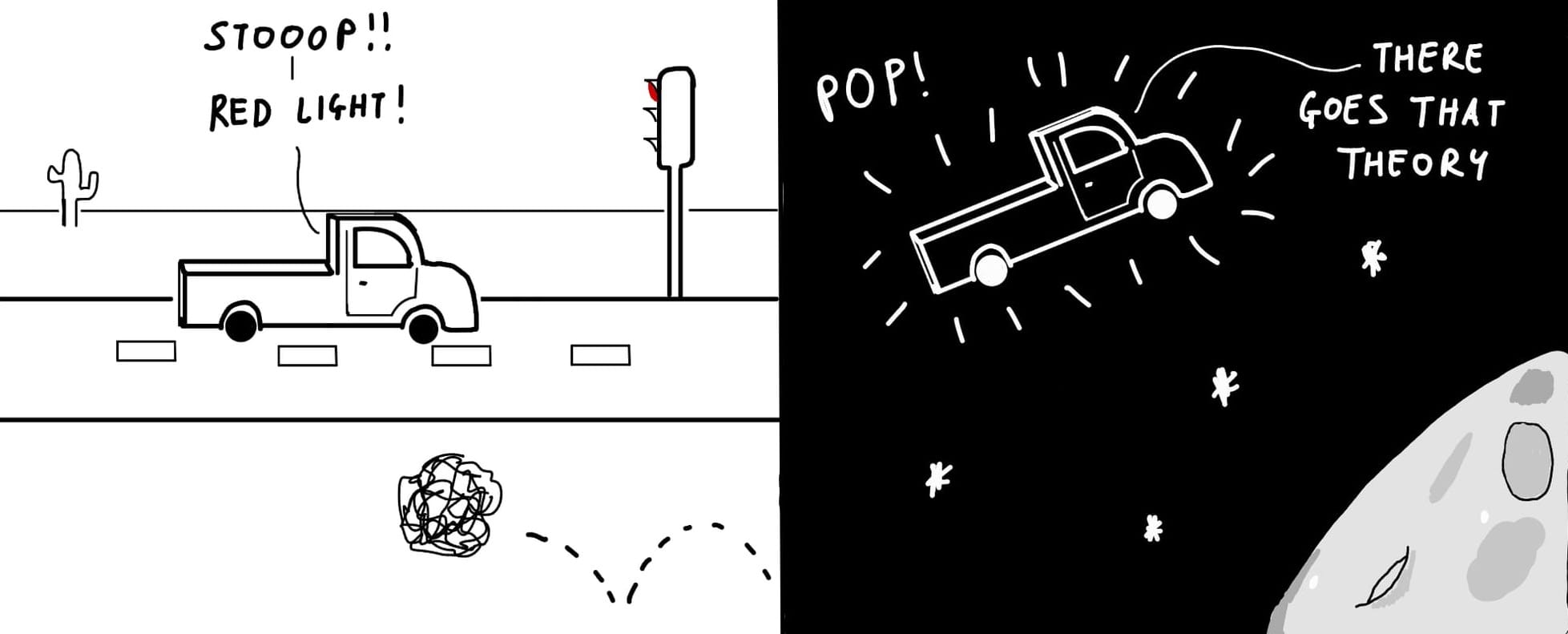
Another way to make a good theory is by starting with good assumptions. Good assumptions are a set of rules which we know are true from an experiment and which we cannot break. A theory that follows its own rules is called 'self-consistent'. This helps us be confident that a theory is right because it bases the theory on things we know to be true.
In reality no one can ever be 100% sure if a theory is true. For example, we can't see how some really small particles (like electrons) move, so we can't ever check that a theory for how they move is exactly true. We can only test a theory using information that we are able to measure. As long as the theory is based on good assumptions and makes predictions that agree with experiments, we can keep using it to make more predictions until it stops agreeing with experiments. Then we have to change the theory or come up with a completely new one.
Effective Theory
In my master's project, I am using the idea of an 'effective theory' to try to predict what happens when we smash two particles called pions together. A 'fundamental theory' is our current most accurate theory for describing something. You can think of these theories as describing what is really going on. In contrast, the goal of an effective theory is to be the simplest theory that still describes the outcome of a certain experiment accurately. It should give us the right predictions but not necessarily explain everything that is going on.
To make an effective theory there are two key ingredients:
- Keep only the relevant 'degrees of freedom' - this just means we get rid of any parts of the fundamental theory that don't describe the specific experiment that we want to make a prediction about. This makes the explanation as simple as possible which helps with making predictions easier.
- Keep the same symmetries as the fundamental theory. A symmetry in physics is any change you can make to the environment that won't change how the physics works. For example, if you use your phone in Edinburgh or in New York, the phone will work in exactly the same way. So we say that electromagnetism, the theory that describes how electricity works, has a 'translational symmetry'. Translation here just means moving.
As an example of an effective theory, let's take a look at gravity. The gravitational force between two objects is described by the equation,
\[F = \frac{Gm_1m_2}{r^2} \;. \]
Where \(G\) is a number that scientists have measured in experiments and \(m_1\) and \(m_2\) are the masses of the two objects. You can think of mass as telling you how heavy something is. The quantity \(r\) is the distance between the two objects, so by looking at the equation, you can see that the force bringing the two objects together gets weaker the further apart they are. This equation describes a theory for how gravity works.
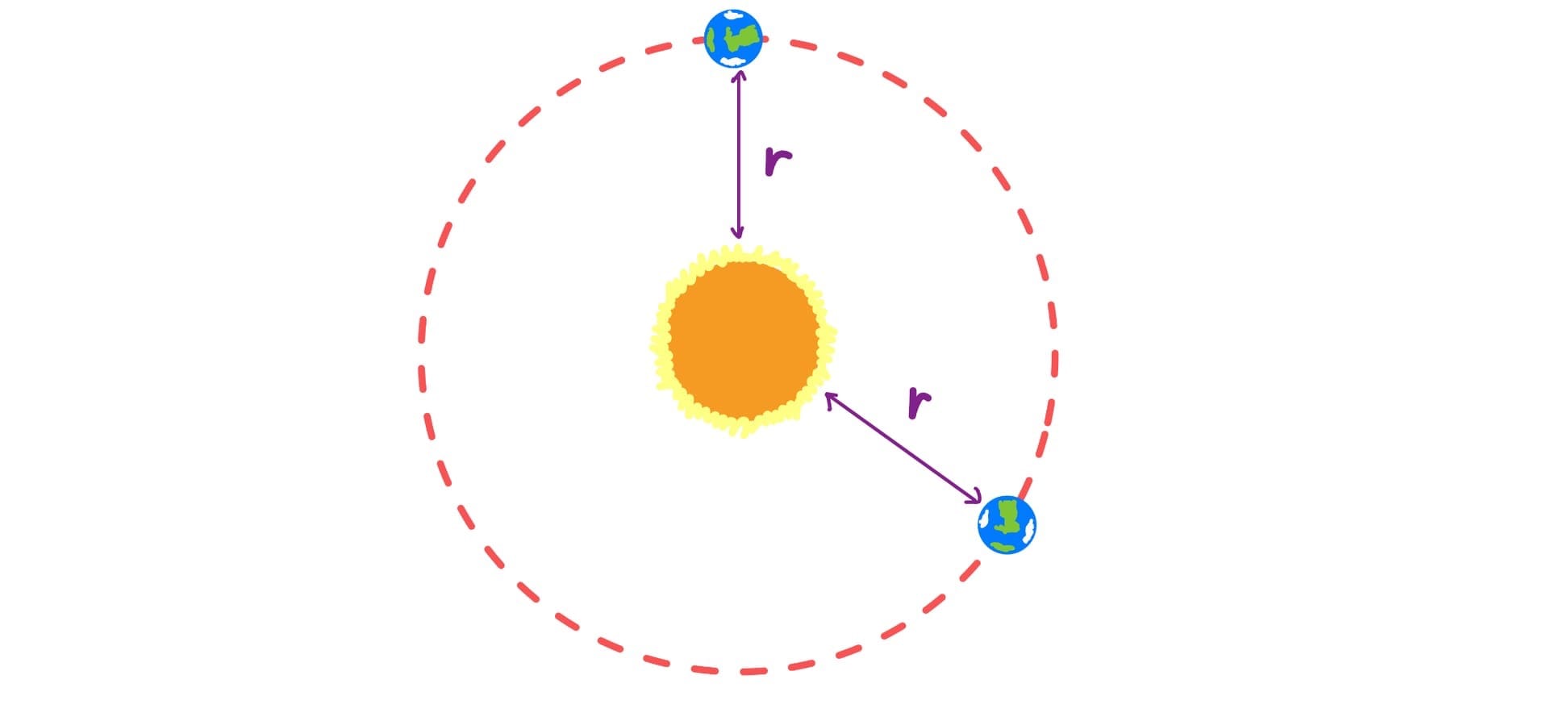
This force has an important symmetry! If you keep the distance \(r\) between the two objects the same, the force of gravity stays the same. For example, if we keep the sun at a fixed point in space the earth will experience the same gravitational force as long as it stays anywhere on a sphere (with a fixed radius \(r\)) around the sun- have a look at the diagram if this is confusing. We call this symmetry 'spherical symmetry'.
Now, we all know that on the surface of the earth the force due to gravity is roughly fixed. If you imagine jumping at home or jumping on a really high mountain, you wouldn't be able to tell the difference for how quickly you fall, even though on the mountain you are further away from the centre of the earth. It is simple enough to say that the force we feel on earth due to gravity is,
\[F = mg\;.\]
In this equation \(m\) is our mass and \(g = 10 \text{m}/\text{s}^{2}\) is another number that we can measure by doing an experiment - it tells us how quickly we speed up when we fall. We can call this an effective theory of gravity because it is an approximation of the fundamental theory which was described by the previous equation.
Let's check that this is really a good effective theory. First, does it contain only the necessary degrees of freedom? On the surface of the earth, our distance from the earth's centre is roughly fixed, even if we jump we aren't moving that far compared to the size of the earth. So our effective theory ignores the distance between us and the earth - there is no \(r\) in our equation. Remember \(r\) tells us the distance between two objects. Also, the earth's mass is always the same, so we can leave it out of the equation. The only necessary degree of freedom now is our mass, which we have included in the equation.
Next, does it have the right symmetry? Our answer is also yes! The fundamental theory has spherical symmetry. The effective theory predicts that anywhere on the earth's surface we will feel the same force due to gravity. Anyone standing on the surface of the earth is the same distance away from the centre of the earth. So this effective theory also has spherical symmetry.
Notice also that calculating the force is much easier for the new effective theory, we need to put less numbers into the equation. This same idea is used in my master's project! The force that describes how pions interact with each other is called the strong force. The equations we get from the fundamental theory describing this force are too difficult to be solved, but using the effective theory we can find a nice solution that matches experiments.